




3-Year Cash Flow Model: Predicting the Payback Period for Indoor Playgrounds
For the majority of Family Entertainment Center (FEC) investors, the greatest source of stress is the unknown. Every investor goes to other industries and is told, “You will get your money back after 18 months,” yet very few can show you the numbers. All you get is a financial model that is not clear, and you have to estimate risk instead of managing it. This guide is designed to change that, offering a transparent, customizable, and data-driven 3-Year Financial Model designed for investors in indoor playgrounds, commercial real estate developers, and asset management companies.
By the end of this article, you will be able to see exactly how the payback period is calculated and how the speed of your return relies heavily on the management of your CapEx and OpEx.

Model Foundation — The Three Core Input Variables
There are three primary variables for creating a dependable payback calculator for an indoor playground. These elements influence every financial projection as well as the precision of your 3-year prediction.
1. Analysing Capital Expenditure (CapEx)
Capital Expenditure or CapEx is the total initial investment needed to design, construct, and open your indoor playground. Underestimating CapEx is a common reason why investors face delayed payback.
A professional FEC build usually gets separated into the following ratios:
- Playing Equipment 60%
This consists of your soft-play structure, ninja course, interactive zones, trampoline parks, climbing walls, themed decorations, and installation.
- Building and Infrastructure (25%)
Includes electric systems, HVAC, flooring, fire safety, plumbing, lighting, ceiling reinforcement, and other facility upgrades.
- Pre-Launching and Active Capital 15%
This consists of marketing, staffing, training, permits, software systems, POS setup, insurance, supplies, and cash reserves for the first several months.
Having a well-organized CapEx estimate will help to alleviate hidden costs, keep your project on budget, and provide your financial model with a launching point.
2. Revenue Drivers: Fuel of the Financial Model
Your playground does not hinge solely on ticket sales. The value of your revenue model is determined by how well you enhance the value of every visitor.
The three most important drivers include:
Traffic Prediction
Create traffic forecasts using three different situations: cautious, moderate, and hopeful. This is integral for calculating how sensitive your payback period is for your scenarios.
Average Guest Spend
Average spend per guest includes everything that guests buy, such as entrance tickets, food, arcade and game credits, retail, and birthday parties. Getting guests to spend an extra one or two dollars increases your gross annual profit.
Rate of Customer Retention
Having memberships, loyalty programs, and season passes creates a stable, predictable, and recurring cash flow. High retention will result in a more predictable cash flow and quicker payout of the costs needed to develop the programs.
3. Operating Expenditure (OpEx) Control
OpEx includes the expenses involved in operating your indoor playground on a day-to-day basis, and the main factor in recovering your investment in the playground in the shortest period of time possible is managing your variable costs, while maintaining your fixed costs at a constant level.
Fixed Costs
These are costs which remain constant over a period of time and include Rent, salaries, insurance, utilities in the baseline, software subscriptions, as well as long-term contracts.
Variable Costs
These are costs which are directly proportional to the level of output in the short term and include Hourly staff, consumables, marketing costs, cleaning materials, supplies for birthday party packages, and upkeep.
With effective management, the operators would be able to achieve as much as an additional 20% reduction in OpEx, which directly translates into increasing the net cash inflow and shortening the period to recover the capital costs incurred.

Core Formula and Risk Warning
1. Defining the Payback Period
The payback period indicates how long it will take you to recoup your initial capital expenditure (CapEx) through annual net cash flow.
To calculate the payback period, you will use the following standardized formula:
- Payback Period (Years) = Initial Total Investment (CapEx) + Annual Net Cash Flow
- Payback Period (Years) = Annual Net Cash Flow + Initial Total Investment (CapEx)
It is critical to differentiate:
- Net Profit = Profit after expenses have been deducted
- Cash Flow = Net Money in hand to conduct business
Payback is based on cash flow, not profit, because cash flow alone dictates your ability to pay your business obligations each month.
2. Caution: Avoid The Cash Flow Trap
Many investors make the assumption that being profitable equals cash flow, which is often not the case, and can lead to catastrophic outcomes. For instance, places that make money, like indoor playgrounds, can still face cash shortages due to:
Paying off loans
- Dips in customer traffic based on the season
- Staffing needs in the maintenance phase
- Routine maintenance schedules
Why Cash Flow Drops Early
A number of new FEC investors equate significant revenue with equally significant liquidity. This is erroneous.
- Why Cash Flow Dips Early
- Repayments of loans
- Seasonal cycles of revenue
- Staffing imbalances
- Inventory and maintenance cycles
Your operational projection model for three years needs to be based on a monthly, rather than annual, revenue projection for cash flow. This is important to avoid liquidity shortages.
How to Avoid the Depreciation of Equipment
It is because of such issues that you must build your financial model using cash flow, rather than net cash flow. Using monthly cash flow metrics will decrease your chances of running out of cash and protect you from running out of cash during the first 12-18 months, even with projected net profits.
This is a big problem that a lot of new FEC investors run into - they see a high revenue stream and automatically assume they have a lot of disposable income. However, this is far from the truth. There are many reasons the available cash can drop and leave you in danger of running into a liquidity problem.
- Paying off loans
- Revenue seasonality
- High staffing levels
- Fulfillment and maintenance cycle demands
Your 3-Year Model should be based on monthly, rather than yearly, cash flow. This is critical to avoid running into liquidity problems.
Scaled Case Studies and Three-Year Projections
To better illustrate how the payback period is affected by different-sized facilities, consider three benchmark models, which are industry standards in the FEC industry.
Comparison Table: 3-Year Indoor Playground ROI Benchmarks
|
Facility Type |
Estimated CapEx |
Revenue Strength |
Payback Period |
|
Small Community Center |
$300k–$600k |
Birthday-focused revenue, weekend peaks |
24–36 months |
|
Mid-Sized Theme FEC |
$800k–$1.8M |
Balanced income: ASPG + memberships + café |
18–30 months |
|
Large Flagship Anchor Facility |
$2.5M–$6M |
Multi-zone monetization with high daily traffic, premium attractions |
30–48 months |
Case Study Example: Mid-Sized Theme FEC
The mid-sized theme FEC constructed with a total CapEx of around $1.2 Million has one of the most dependable benchmarks for indoor playground investors. It creates nearly $2 million in annual revenue with 12,000 monthly foot traffic and $14 ASPG. The revenue is generated through diversified streams such as birthday party bookings, cafe sales, membership subscriptions, and arcade game reloads. The FEC has optimized the annual operational expenditure to $1.2 million, and the facility has a healthy annual net cash flow that grows each quarter.
During the first year of operations, the business typically nets $350,000 cash flow, and in Year Two, the net cash flow accelerates to $Mitigated mar $ 000 million based on consistent market traffic, extensive membership retention, and efficient operational management to net the facility >50% of the total cash flow needed to cover all operational expenses. Overall, most mid-sized FECs that used this cash flow-management strategy totally recoup their cash flow in 2.5 years based on this operational and pricing model, making this scale most attractive for new investors looking for a 3-year financial projection.
Overview:
CapEx: $1.2M
Monthly Traffic: 12,000 visitors
ASPG: $14
Annual Gross Revenue: ~$2M
OpEx (Optimized): ~$1.2M annually
Quarterly Cash Flow Accumulation Over 3 Years:
|
Quarter |
Net Cash Flow |
Cumulative Cash Flow |
|
Q1 |
$40,000 |
$40,000 |
|
Q2 |
$60,000 |
$100,000 |
|
Q3 |
$110,000 |
$210,000 |
|
Q4 |
$140,000 |
$350,000 |
|
End of Year 1 Total |
— |
$350,000 |
|
Q5 |
$160,000 |
$510,000 |
|
Q6 |
$170,000 |
$680,000 |
|
Q7 |
$180,000 |
$860,000 |
|
Q8 |
$200,000 |
$1,060,000 |
|
End of Year 2 Total |
— |
$1,060,000 |
|
Q9–Q12 |
Remaining cash flow |
CapEx fully recovered before Year 3 end |
Conclusion
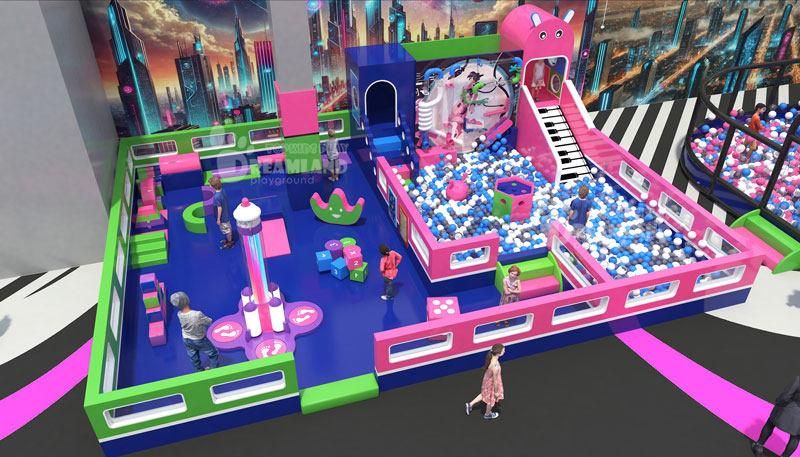
One thing a small and successful theme FEC demonstrates is that strategy is more important than size. Features like immersive theming, smart zoning, high-yield attractions, and repeat visitation grow facility performance to that of a major park, without the investment cost. This is the reason operators are turning to 800 to 1,500 m2 themed FECs for quick payback, foot traffic, and profitable multi-year returns: the performance of these facilities when designed properly is unmatched.
If your goal is to build an FEC and attract families since day 1, maximize ROI, and remain competitive for years, Dreamland Playground is the partner you need. We oversee all aspects from concept, theming, and design, to manufacturing and installation, to lifetime operational support for your facility to be safe, beautiful, and profitable.
Let's work together to make your idea into a successful themed family entertainment center. We provide you with a place that is prepared to assist you in creating and constructing your vision for success.
Frequently Asked Questions (FAQ)
Q1. How long does it take to design and build an indoor playground?
Typically, the entire process takes 4-7 months to complete, depending on design complexity, permitting, and the installation schedule. This timetable is essential for your budget planning because it will influence how money comes in during the initial period.
Q2. How much contingency should I add to my CapEx?
A 10-15% is standard to cover construction changes, compliance changes, and add upgrades to the CapEx.
Q3. Which pricing model delivers the best ROI?
When it comes to reducing the effects of the off-peak season, predictable revenue is generated through memberships, prepaid passes, and loyalty programs
Q4. What is the biggest OpEx threat in year 2?
It is the unexpected equipment failure and maintenance conducted reactively. Predictive maintenance minimizes downtime and stabilizes cash flow.
Q5. How does a traffic drop affect the payback period?
A drop in footfall of 10–15% can increase your payback period by several months. Make your projections with more conservative traffic estimations and increase your retention programs with more strength.