




Small Space, Big Ideas: Maximizing the Design Potential of a 1,000 Sq. Ft. Indoor Playground
When considering getting into the playground industry, the biggest concern for potential indoor playground owners isn’t customer interest; it is the substantial initial investment associated with the industry, as well as the long-term financial commitments that are required with indoor playground rentals. The indoor playground industry requires large spaces (5,000 - 10,000 sq. ft), which incur large long-term lease obligations that are difficult to financially manage. The indoor playground industry also requires large startup investments to initially finance the indoor playground equipment and recruit employees. All of the financial obligations required in the indoor playground industry can discourage passionate entrepreneurs before they get a chance to run the business.
In today’s economy, families value local, convenient entertainment options that are also safe. Families are now willing to pay more for well-designed, boutique indoor play centers. The economic shifts in families with children have enabled the indoor playground industry to focus on new business models, such as the 1,000 sq. ft indoor playground.
This article has the most efficient blueprint to help you turn a bordered space into a profitable playground area.
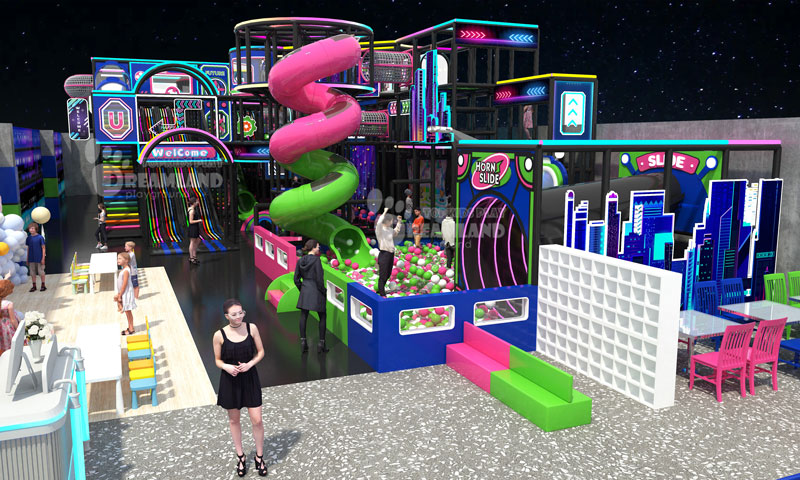
Financial Strategy: The Low-Risk Model for Indoor Playground Investment
1,000 square feet (or about 100 square meters) is often seen as a constraint in the industry. This view should be flipped, as some of the most successful indoor playground operators in the US view this as a low-risk, high-efficiency indoor playground footprint. Let’s review the cost comparison table.
Cost Comparison: 1,000 sq. ft. vs. 5,000 sq. ft. Indoor Playgrounds
|
Metrics |
1,000 sq. ft. Playground |
5,000 sq. ft. Playground |
|
Startup Capital |
$50,000–$100,000 |
$200,000–$450,000 |
|
Monthly Rent (US Avg.) |
$2,500–$5,500 |
$12,500–$25,000 |
|
Operating Staff |
1–3 employees |
6–12 employees |
|
Time to Open |
60–90 days |
120–180+ days |
This learner model reduces exposure from day one.
Hard Costs vs. Soft Costs
Hard costs pertain to the actual expenses involved with the construction of your 1000 square foot indoor play space that includes the play equipment, vertical components, flooring, safety padding, and installers. These expenses are fixed because they are the only appropriate and conclusive factors that define the build of your facility. Soft costs, on the other hand, are all other non-tangible expenses that are, however, equally crucial, are comprise the architectural designs and diagrams, permits, compliance reviews for ADA and fire codes, insurance deposits, marketing for the initial stages, and the working capital for the first 2-3 months of business operations. A successful business plan separates:
Hard Costs:
- Vertical play structure (largest line item)
- Soft-play components
- Safety padding and flooring
- Installation, carpentry, and minor electrical
Soft Costs:
- Permits (city, fire, health)
- Architect/engineering fees
- Opening marketing campaigns
- 2–3 months working capital
Accelerated Payback Cycle
Large outdoor play areas tend to take 36–60 months to achieve breakeven. In terms of potential revenue, a 1000 square foot venue should be able to achieve breakeven in 12–18 months due to:
- Lower Debt Load
- Lower Rent
- Fewer Employees
- Service High Margin Offerings (especially party services)
- Deliver A Small but Premium Customer Experience
For investors who want a quick, steady, and predictable path to market entry, this model represents one of the fastest to return entertainment options in the US today.
Precision Positioning: Defining Your High-Margin Vertical Niche
In this scenario, smaller playground venues do better, but not because they are broader. It is because they are precise. It is not about play style, age. It is about going small and deep that maximizes ROI.
Niche 1: 0–6 Age Group Focus
A younger demographic requires:
- Lower fall heights
- Softer play components
- Higher safety assurance
- Educational/interactive elements
This demographic is also the most dependable regarding repeat business. Mom and dads with toddlers require safety and certainty in an indoor play space—perfect for the acquisition of memberships, monthly subscription passes, and services geared towards the business's weekday activities.
Monetization Opportunities:
- Unlimited play memberships
- Weekday parent-toddler classes
- Sensory play sessions
- Snack/café upsell for parents
Niche 2: Theme Party Market
Small indoor playgrounds do birthday parties almost exclusively for profit optimization.
Small venue birthday parties can command premium prices because customers are willing to pay for:
- Exclusivity
- Safety
- Customization
- Stress-free hosting
High-margin options include:
- Silver, Gold, and Platinum packages
- Custom themes (Princess, Space, Superhero, Underwater)
- Decor packages
- Party hosts
- Character appearances
- Professional photography add-ons
Small venues can easily become local *specialists* for premium themed parties—a huge competitive edge.
Risk Mitigation and Scalability Advantage
A 1,000 sq. ft. model is inherently more resilient.
Low Inventory Risk
A compact footprint means:
- Easier lease approvals
- Faster buildouts
- Simpler exits or expansions
- Lower moving costs if relocating
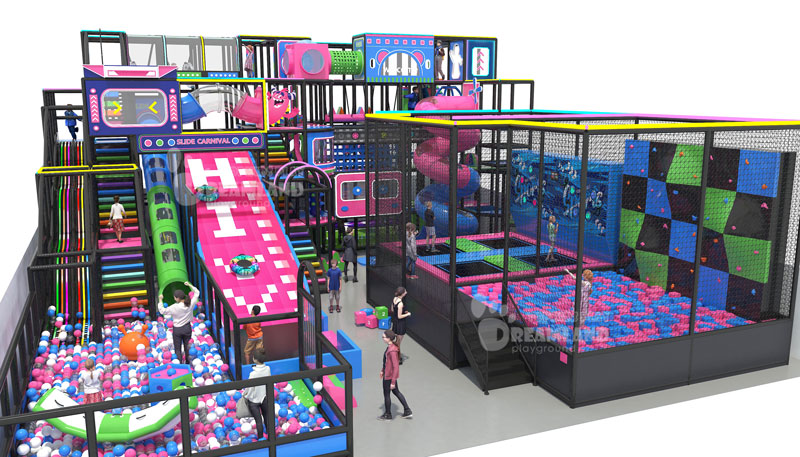
Design & Efficiency: How Vertical Play Structures Maximize 1,000 Sq. Ft.
Vertical Space Utilization: The Power of Multi-Level Play Structures
The enchantment of a 1,000 sq. ft. indoor-play area comes from the goal of going up, not out.
Vertical Play Structure = More Play in Less Footprint
Employing double-decker or triple-decker systems allows operators to effectively double or triple the play area while keeping the same footprint.
A 200 sq. ft. floor section with a triple-decker system would be:
- 400 sq. ft. = 2 levels
- 600 sq. ft. = 3 levels
This differentiation of play systems allows small spaces to be transformed into play environments that feel larger than they actually are.
Value Generation
The children and parents seem to appreciate the 'premium' feel of these environments. Furthermore, these structures become 'tall,' which they seem to appreciate even more.
Aesthetic Differentiation
The small scale is even more a threat by a strong themed design. Possible themes include:
- Jungle Adventure
- Space Exploration
- Underwater World
- Candy Land
- Construction Zone
Theming helps foster layering of emotional sentiment, amplifies photo-sharing, and helps strengthen revisiting.
High-Yield Equipment to Include:
- Multi-story obstacle zones
- Spiral slides (high drop-to-footprint ratio)
- Overhead rope or net walkways
- Viewing platforms
- Mini climbing towers
In conjunction, these yield a high factor of osmosis which drives high of osmosis.
Multifunction Integration: Low-Footprint Equipment for Multiple Revenue Streams
Every square foot of space ought to produce several different functions.
Recommended Multi-Use Equipment
- Floors with digital interactive projection: Excellent for youngsters and older children, these floors are great for events.
- Climbing walls: A unique, space-saving attraction
- Themeable soft modular blocks: Quick to re-theme and can be used differently for classes and birthday parties.
No additional labor is needed with these elements.
Modular Party Room = Ultimate Versatility
One room can serve as:
- A party room on the weekends
- A parent lounge on the weekdays
- An art and craft classroom during off-peak times
- An exclusive birthday party room or private preschool event space
This kind of versatility greatly enhances revenue per square foot.
Flow Optimization and Parent Comfort Zones
A small playground should project a sense of openness, security, and tranquility.
ADA Compliance Is Mandatory
Although it may be a 1,000 sq. ft. project, one still has to follow US ADA guidelines, including:
- 36-inch wide pathways
- Provision of restrooms
- Accessible seating
- Adequate seating
- Thoughtful designs can save time and money.
Clear Circulation for Families
An active and clear flow of people allows easier supervision of children and safe entrances and exits during busy times. Children can move freely without flow restrictions, especially in multi-level designs.
- A playground design should accommodate 20-30 children.
- Increased Revenue Through Thoughtful Design of Parent Areas
Comfortably furnished designs that provide shade and places to rest prolong visitation. Consider:
Parent Seating = Revenue Booster
- Charging outlets
- Comfortable seating
- Good Wi-Fi
- Visibility of play structures
- A mini coffee/snack bar (high-margin)
Relaxed parents stay longer—and spend more.
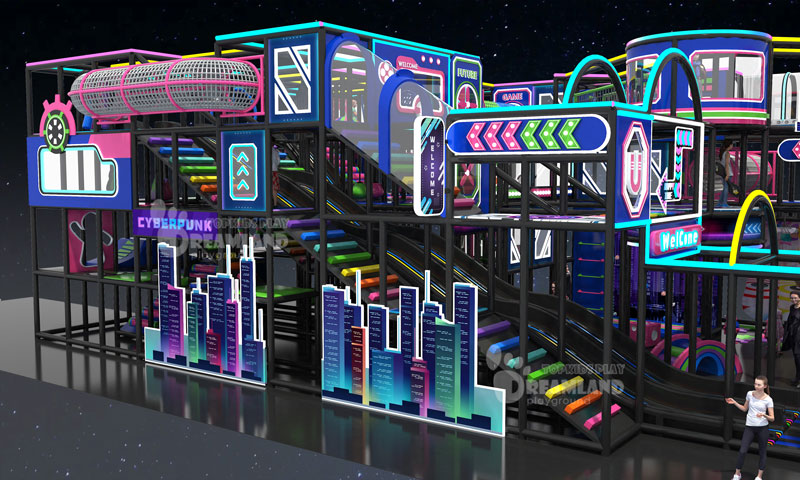
Operational Success: Revenue Diversification and Safety Compliance
Breaking the Single-Income Barrier: The Golden Ratio for Revenue Diversification
The resilient playground with an area of 1,000 square feet enjoys a 50/50 revenue split as follows: 50% is from gate tickets, 50% is from value-added services. Having that balance protects the business from the effects of seasonality.
- 50% Gate Tickets
- 50% Value-Added Services
The revenue stream that has the most margin is from the theme party packages.
High-Margin Revenue Streams
1. Theme Party Packages
There can be tiered packages that include silver, gold, and platinum, and those can be introduced with private playtime, custom decor, host and supervisor, character meet and greets, catering and cake, and documentary photography.
- Private playtime
- Custom decor
- Hosts and supervisors
- Character meet-and-greets
- Catering and cake add-ons
- Photography/videography
2. Parent Amenities
Seamless execution should be offered by the training of staff, and customer experience that is driven by seamless execution is why sales can be repeated.
- Coffee
- Smoothies
- Packaged snacks
- Mini pastries
Margins average 65–80%.
3. Passive Income
Businesses with zero or low additional labor costs can provide:
- Merchandise with brand logos
- Vending services
- Services offered by partners such as photography or enrichment courses
These create revenue with no added complexity.

Safety and Compliance: Project Lifeline and Risk Control
Compliance in the U.S. market is critical.
ASTM Standards
For soft contained play equipment, ASTM F1918 applies to your playground. Dreamland Playground designs every structure to comply with these national safety requirements.
Insurance Requirements:
Obtain commercial general liability insurance. It is usually simpler and less expensive for smaller venues, due to:
- Lower height of equipment = lower risk
- Limited capacity = more controlled setting
Risk Management Essentials
- Daily opening/closing safety checklists,
- Documented maintenance logs
- Comprehensive SOPs for staff
- Certified, reputable vendors for equipment.
Your brand protection and safety are the most important part.
Community Engagement and Low-Cost Marketing
Local Partnerships
Partner with:
- Daycares
- Preschools
- Libraries
- Elementary schools
- Local mom groups
Providing discounts, annual arrangements, service, and scheduling field trips for weekdays for field trips can mitigate challenges.
Social Media Advantage
The well-decorated and small spaces with a particular theme have a striking visual appeal. It is worth featuring:
- Vertical play structure
- Spiral slide
- Themed decor
- Birthday setups
Eye-catching displays that are shareable on social media enhance organic outreach and instigate conversation on the topic.
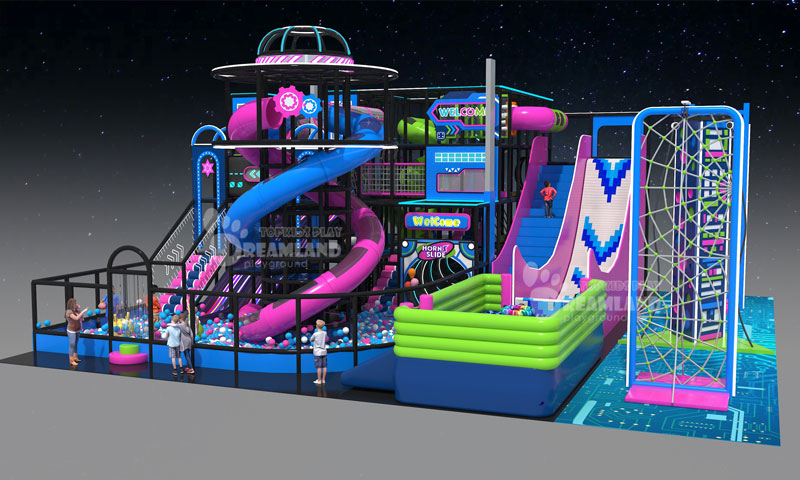
Summary
A design incorporating a 1,000 square foot indoor playground is not merely an indoor playground, but rather a genius innovation to tackle the economic challenges. Today, this design model is the most balanced and profitable form of entertainment investment in the US while maintaining low costs, shifting staffing needs, efficient design, and a variety of revenue streams. Success hinges on three of the most important foundational stones:
- Low-Risk Finance: diminished capital, quicker ROI, minimized staffing.
- Vertical Design: Constructing multi-level structures to maximize value and to promote value-adding exercise in a limited area.
- Diversified Operations: passive revenue streams, amenities, memberships, and parties.
This strategy will help you design a high-performing, efficient indoor playground. For most, the most reasonable choice to begin this process is the 1,000 square foot model design. Good luck building a low-cost, high-variety indoor playground that targets a specific market. This is the model you need to profit from an indoor playground investment in a timely fashion. Contact Dreamland Playground and obtain a cost estimate and a customized design layout of the 1,000 square foot space, free of charge, to begin.
Frequently Asked Questions (FAQ)
Q1. What is the estimated startup capital needed for a 1,000 sq. ft. indoor playground?
We recommend budgeting for indoor playground equipment of $50,000 to $100,000, depending on the desired finishes and complexity of the structure (excluding HVAC, fire suppression, and tenant improvements). Please reach out to our consultants for the most accurate pricing.
Q2. How many children can a 1,000 sq. ft. space safely accommodate at one time?
The optimal, comfortable, and efficient design flow for multi-story structures is 20 to 30 children per story.
Q3. Which types of equipment are best suited for a 1,000 sq. ft. indoor playground?
Equipment that gives the highest return includes:
- Multi-level vertical play structures
- Interactive projection games
- Modular soft blocks
Q4. What is the typical ROI period for a 1,000 sq. ft. indoor playground?
Because of the low initial investment and the high-margin services, for successful operators, the target payback period is 12 to 18 months.
Q5. Does your design service include guidance on construction, fire safety, and ADA compliance?
Yes. Dreamland Playground provides layouts and specs that meet ASTM Guidance, ADA, and local Fire/Health Code requirements, ensuring smooth approval for safe operation.