

Fire Safety Materials for Commercial Indoor Playgrounds: What Buyers Should Check Before Ordering
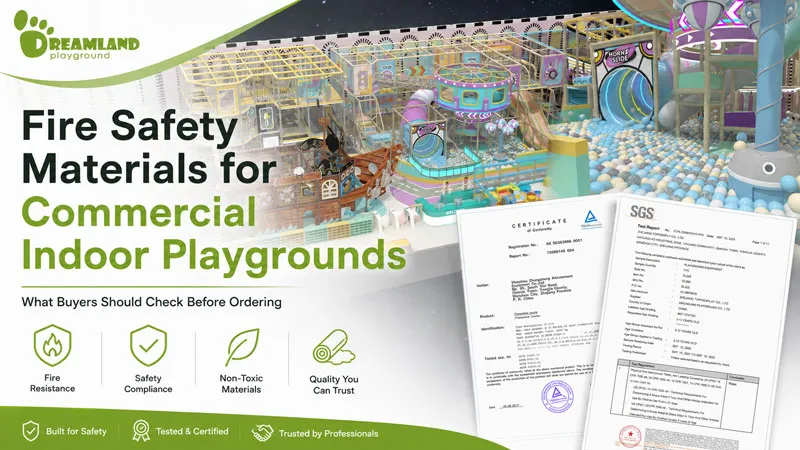
To invest in a commercially operated indoor playground with promising growth prospects, investors need to compare various suppliers when selecting different equipment, so as to pick the facilities that can maximize profits for their project. When investors choose equipment and screen suppliers, their key considerations usually revolve around venue design, play theme, equipment pricing, and project completion timeline.
However, many investors tend to overlook one critical point: operating a commercial indoor playground requires compliance with safety standards and business licenses. Among all safety certifications, fire safety materials for indoor playgrounds—though often overlooked—play a decisive role in the operation of indoor playgrounds, as commercial indoor playground fire safety regulations impact administrative approval, insurance coverage, project inspection, and long-term operation.
To help investors resolve safety certification issues encountered when operating an indoor playground, this article introduces fire safety materials for indoor playgrounds and lists key questions to confirm with suppliers prior to purchasing equipment.
Why Fire Safety Materials Matter in a Commercial Indoor Playground
Children and families constitute one of the core customer groups for commercial indoor playgrounds. Therefore, when investors ponder how to boost the appeal of playgrounds, they will first take into account the consumption demands of target customers. When parents pick out different playgrounds for their kids, safety is their top priority. An indoor playground with reliable safety guarantees is far more likely to attract parents to bring their children for visits and consumption.
To maintain the profitability of commercial indoor playgrounds, investors usually need to build them in high-foot-traffic areas and sometimes even set them up inside shopping malls. Therefore, operating an indoor playground requires compliance with applicable local building and fire safety codes, as well as any permits, inspections or approvals required by the local authority having jurisdiction. Inspection procedures and frequencies vary by location. As commercial venues designed for children, indoor playgrounds may receive particular attention during fire-safety reviews. Ensuring commercial indoor playground fire safety is the foundation for its long-term operation.
Another easily overlooked factor is the hidden cost—insurance premiums. Indoor playground operators commonly purchase liability, property and other relevant insurance. The types of insurance legally required—or required by landlords, lenders or business partners—vary by location and project. Strong safety controls may support an operator’s risk-management efforts and may be considered during insurance underwriting, although premiums depend on multiple factors. The indoor playground equipment for children’s play includes combustible materials such as fabrics, foams and plastics. Equipment made with appropriately tested fire-retardant materials can help slow ignition or flame spread, but it does not eliminate fire risk or guarantee lower operating costs.
Common Fire Safety Materials Used in Indoor Playground Equipment
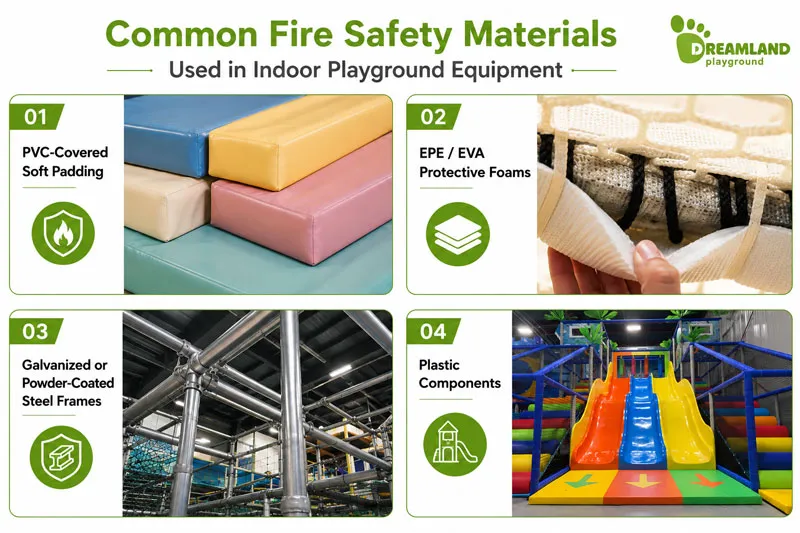
Common fire-retardant indoor playground materials are as follows:
PVC-covered soft padding
Thanks to its soft texture, this type of soft padding is commonly used as shock-absorbing floor mats in indoor playgrounds to prevent children from getting bruised or injured from collisions. The PVC-coated surface is smooth and easy to clean, so it is widely applied in high-traffic areas such as ball pits and climbing blocks.
PVC coatings are categorized into flammable and flame-retardant types, with different flame retardancy ratings corresponding to various material standards. You need to confirm the flame retardant labeling of the products with your supplier before purchasing.
EPE/EVA protective foams
EPE boasts excellent elasticity, and it is waterproof, moisture-proof, and non-toxic. It can be cut freely into various shapes to fill all kinds of gaps for shock absorption, so it is frequently used as a protective cushioning material that is commonly applied to the inner filling of all kinds of soft play equipment.
EVA materials do not inherently feature fire resistance; their fireproof performance is affected by density, thickness, and the fire retardants adopted. Manufacturers usually add fire retardant additives into EVA foams to enhance fire resistance, and this point needs to be confirmed with the supplier.
Galvanized or powder-coated steel frames
Steel boasts outstanding strength and stability and is frequently used as the main frame of amusement equipment. A layer of zinc or powder is coated on the steel surface to guard against rust and corrosion. Galvanized or powder-coated steel frames, as a type of steel product, are non-combustible materials.
However, under high-temperature combustion conditions, the zinc or powder coating attached to the surface of galvanized steel will lose its anti-rust and anti-corrosion properties. Over time, the steel will corrode, creating potential hazards such as loosening and falling off of the equipment. Therefore, an additional fire-resistant coating is applied to the steel surface to boost its fire resistance.
Plastic components
Most slides, panels and play elements will adopt plastic components. Such plastic materials are generally safe and non-toxic. The fire resistance of flame-retardant plastics varies in accordance with specific fire rating standards, such as HB, V-2, V-1 and V-0 under the UL 94 standard, as well as Grade A (non-combustible) and Grade B1 (hardly combustible) commonly used for building materials.
Flooring
Different materials are adopted for floor decoration in different areas. Continuous flat soft mats made of fire-retardant-treated or fire-retardant-added EPE foam and sponge are used in the Toddler Zone. By contrast, wood or hard plastic coated with fireproof coatings are utilized to build varied levels and obstacles in the Active/Junior Zone.
Decorative Fabric
Decorative elements are usually accessories that enhance the ambiance of venues, such as lighting designs. Lamp housings can be made of glass or safer plastic materials. Glass itself is non-combustible, yet it carries the risk of falling shards compared to plastic. Lamp housings made of plastic coated with a fire-resistant layer or flame-retardant treated plastic offer a certain level of fire resistance.
Fire-Retardant Does Not Mean Fireproof
Investors may assume that materials described as fire-retardant are also fireproof. This assumption is misleading because fire-retardant performance does not mean that a material will not burn or retain its function indefinitely during a fire. In indoor playground equipment, most materials other than steel are combustible and should not be described as fireproof.
In technical specifications, it is more accurate to distinguish among non-combustible materials, flame-retardant materials, and fire-resistance-rated assemblies. Non-combustible materials are evaluated for combustibility; flame-retardant materials are designed or treated to reduce ignition or flame spread under specified test conditions; and fire-resistance-rated assemblies are tested to maintain certain functions for a defined period. These terms are not interchangeable.
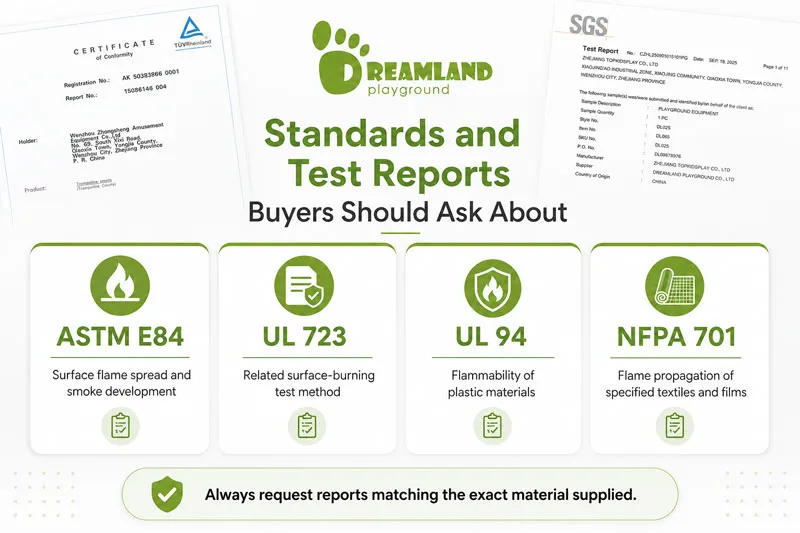
Different standards evaluate different aspects of fire performance. ASTM E119 evaluates the fire resistance of certain building assemblies and structural elements; ASTM E84 and UL 723 evaluate surface flame spread and smoke development of building materials; UL 94 evaluates the flammability of certain plastic materials; and NFPA 701 evaluates flame propagation of specified textiles and films. Therefore, buyers should ask suppliers which standard applies to each material or assembly and request reports that match the exact product being purchased.
Standards and Test Reports Buyers Should Ask About
When purchasing indoor playground equipment, the following common standards are usually involved when discussing fire resistance performance:
ASTM E84/UL 723: ASTM E84 evaluates the surface-burning characteristics of building materials and reports comparative flame-spread and smoke-developed indices. Applicable building codes or project specifications may use these results to assign classifications such as Class A, B or C. UL 723 is a closely related test method. Buyers should confirm which method is accepted by the applicable code, project specification and local authority. These methods are commonly applied to building materials such as wall panels, ceiling boards and decorative panels.
UL94: This standard is formulated by Underwriters Laboratories and is widely used to evaluate the flammability of plastic materials. UL 94 includes several test methods and classifications, including HB, V-0, V-1, V-2, 5VA and 5VB, as well as ratings for thin or foamed materials. A UL 94 rating normally applies to the tested material at the specified thickness and test conditions; it should not automatically be treated as certification of an entire slide or completed playground product.
NFPA 701: Developed by the National Fire Protection Association (NFPA), this standard is used to evaluate flame propagation of specified textiles and films, such as certain curtains, draperies, plastic films and coated fabrics. Floor coverings and carpet systems may be subject to different standards, such as NFPA 253 or ASTM E648. Buyers can ask whether the relevant textile or film has been tested to NFPA 701 and request a report identifying the exact material, construction and test method used.
When you consult suppliers regarding the fire safety materials for indoor playgrounds, you need to request fire test data of product materials tested in compliance with the above standards from them. It will be even more thorough if you can also obtain the fire safety certification reports issued by the factory that manufactures the equipment.
Though these standards carry high authority, not all materials can meet every single one of them. Fire safety standards and ratings vary based on regions, building types, usage purposes, local regulatory authorities, and insurance companies. Therefore, in addition to acquiring relevant reports and documents, investors are advised to verify the requirements with local professionals or competent authorities.
How to Compare Fire Safety Materials Between Suppliers
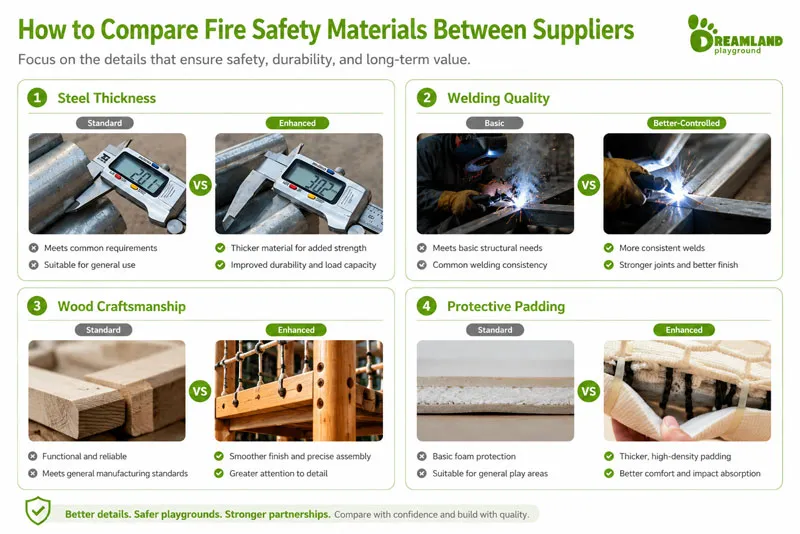
When you search for different equipment suppliers on Google, have you noticed that their product quotations look quite similar? Faced with this situation, you may wonder how to pick the equipment that best meets your fire protection needs from so many suppliers with comparable quotations. To figure this out, you certainly need to carefully compare product details. Although suppliers share many similarities in their product catalogs and quotations, their products actually differ greatly in specific aspects such as raw materials sourced from manufacturers, production technologies, and installation specifications, etc.
Equipment quality varies among different suppliers. If raw materials and manufacturing processes fail to meet the high standards, the equipment will be of mediocre quality. By contrast, high-quality equipment not only uses premium raw materials but also undergoes sophisticated manufacturing processes.
For example, take steel pipes as a reference. Steel pipes of ordinary quality lack sufficient sturdiness. However, steel pipes with a thickness ranging from 2.0 mm to 3.25 mm and treated with hot-dip galvanizing are far stronger and more durable.
Secondly, referring to foam padding, foam padding made of high-density EPE material offers stronger support and higher resilience compared with low-density materials. The glossy bright PVC vinyl on the surface of foam padding also features fire resistance.
You can also refer to the coating of steel frames. If ordinary low-quality colored powder coating is applied on galvanized steel frames, the coating will peel off easily after long-term use. However, the galvanized steel frames with powder coating manufactured by Dreamland Playground adopt advanced Dutch Akzo powder and sand blasting technology, which ensures the sprayed color is more durable, features stronger adhesion, and delivers higher safety performance.
Suppliers pursuing high standards can provide an indoor playground material certificate on the safety standards followed in product manufacturing, as well as data documents of fire resistance tests conducted on products in accordance with standards such as UL 94. Therefore, in addition to comparing product details, you may also conduct a comprehensive comparison by requesting these certification documents from suppliers.
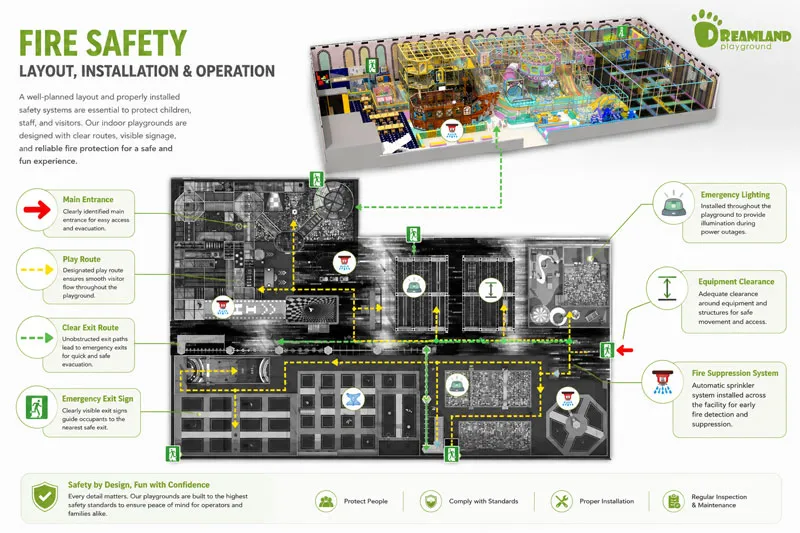
Fire Safety Is Also About Layout, Installation, and Operation
It would be too one-sided to assume that an indoor playground can be operated well simply by knowing what fire safety materials are used in commercial indoor playgrounds. The importance of fire safety in indoor playgrounds is reflected not only in equipment and materials, but also in rational layout design, the installation of emergency equipment and daily operation management. This is exactly what professional indoor playground equipment manufacturers or suppliers with extensive industry experience have been incorporating into their FEC safety plannings.
The layout of high-traffic and low-traffic areas affects crowd movement and evacuation routes in the event of a fire. The permitted occupant load for each space should be calculated according to the applicable building code, the function of the space, its floor area and any requirements imposed by the local authority.
A certain horizontal clearance shall be reserved between amusement facilities, building walls and evacuation passages to design clear pedestrian circulation routes and prevent crowd congestion and blockage during evacuation.
In addition to implementing fire protection measures for electrical equipment used in daily operations, emergency lighting should be provided where required by the applicable code to facilitate evacuation. Where an automatic sprinkler or other approved fire-suppression system is required, it should be designed and installed by qualified professionals. Sprinkler type and placement must account for ceiling conditions, equipment obstructions, hazard classification and the listing requirements of the selected components.
The venue also needs wall-mounted warning decorations for its interior renovation, such as emergency exit signs. In addition, regular fire safety education and fire drills should be conducted for staff to ensure all employees are familiar with evacuation procedures. Only in this way can the fire protection rating of the playground be improved in both hardware facilities and operational management.
What Documents Should Buyers Request Before Production
Before purchasing equipment, investors need to list questions to ask indoor playground suppliers about fire safety, since the more detailed the documents and materials obtained, the easier it is for them to compare quotations from multiple vendors and select equipment products that best fit their needs. A commercial playground supplier checklist is provided below for your reference prior to purchase:
|
Required documents |
Content of documents |
Can the supplier provide it |
|
Material Specifications |
It mainly describes the model and specifications of the product, including size, length, thickness, as well as the product's material, quantity, and place of origin. |
Yes No |
|
Test Report |
Fire-retardant test data of product materials, as well as the corresponding production safety standards complied with by various materials |
Yes No |
|
Layout drawing |
It mainly presents the layout planning of the project, illustrating how various areas with different passenger flow volumes are distributed within the venue through detailed floor plans or 3D renderings. |
Yes No |
|
Installation diagram |
Display the device's accessories, installation procedures, and sequence through pictures, accompanied by written explanations |
Yes No |
|
Packing List |
Company information of suppliers and customers, packing list number and date, product name, model, specification, quantity, packaging information, weight, dimension, shipping information |
Yes No |
|
Maintenance Guide |
Explain the daily maintenance items of the equipment with pictures and text, list possible faults that the equipment may encounter, and provide corresponding repair solutions |
Yes No |
|
Supplier After-sales Support |
The supplier's warranty policy, as well as the warranty period and coverage of the equipment, the supplier's contact phone number, official website address, and the working hours for available after-sales service |
Yes No |
Suppliers with professional teams and extensive industry experience can take a more comprehensive approach to addressing their clients' fire safety concerns. Suppliers chasing quick profits may only sell their equipment, whereas those committed to long-term, in-depth development within the industry will integrate fire safety expertise into project planning.
Staff members of the Dreamland team attend technical training sessions organized by SGS to learn about fire-retardant indoor playground materials, relevant components, and the significance of commercial indoor playground fire safety. The professional team applies the acquired knowledge of fire-retardant materials to design, production, and manufacturing, and delivers turnkey solutions covering transportation and installation support, offering clients a complete and highly secure project planning package.
For investors, focusing on fire safety materials for indoor playgrounds is not merely about paying attention to the technical details of products. From a long-term perspective, it is a fundamental component of long-term operation. Maintaining a high fire resistance rating for your business premises can not only control potential risks, but also help you pass routine fire safety inspections, creating stable development conditions for your commercial project.
If you are interested in fire safety material solutions and project planning, you may send us your venue floor plan, target country, site type, and project area, and Dreamland Playground will provide you with relevant consulting support.
Frequently Asked Questions
Are fire-retardant materials completely fireproof?
No. Fire-retardant materials are designed or treated to slow ignition and reduce flame spread under specified test conditions. They may still burn when exposed to sufficient heat or flame. Buyers should distinguish between flame-retardant materials, non-combustible materials, and fire-resistance-rated assemblies.
What fire test reports should indoor playground buyers request?
Buyers should request test reports that match the exact material, thickness, formulation and intended application being supplied. Common standards may include ASTM E84, UL 723, UL 94 and NFPA 701, depending on the material and project requirements.
Does a UL 94 rating certify an entire playground slide?
No. A UL 94 rating generally applies to a specific plastic material tested at a stated thickness and under defined conditions. It should not automatically be treated as certification of a complete slide, play structure, or finished indoor playground system.
Do all indoor playground materials need to meet the same fire standard?
No. Different materials are evaluated using different test methods. Plastic components, textiles, surface coverings and building assemblies may each be subject to separate standards. Buyers should confirm the applicable requirements with local authorities and qualified project professionals.
Are fire-retardant materials enough to ensure playground fire safety?
No. Material selection is only one part of fire safety. A commercial indoor playground may also require suitable evacuation routes, emergency lighting, exit signage, fire-suppression systems, equipment clearances, staff training and regular inspections, depending on local regulations.