

Indoor Playground Safety Standards for the USA, Europe, and the Middle East
Indoor playground safety requirements differ across the United States, Europe, and the Middle East because each region follows its own building regulations, product safety standards, fire codes, and approval processes. A playground that complies with one market's requirements may still require additional testing, documentation, or design modifications before it can be installed in another. Fire performance, structural integrity, accessibility, and installation practices are often evaluated under different regulatory frameworks.
When planning an indoor playground project, you should evaluate safety as a complete compliance system rather than relying on a single certificate or test report. Equipment standards, fire safety, material compliance, accessibility requirements, third-party inspections, and local authority approvals must all work together to achieve legal compliance and provide a safe environment for children.
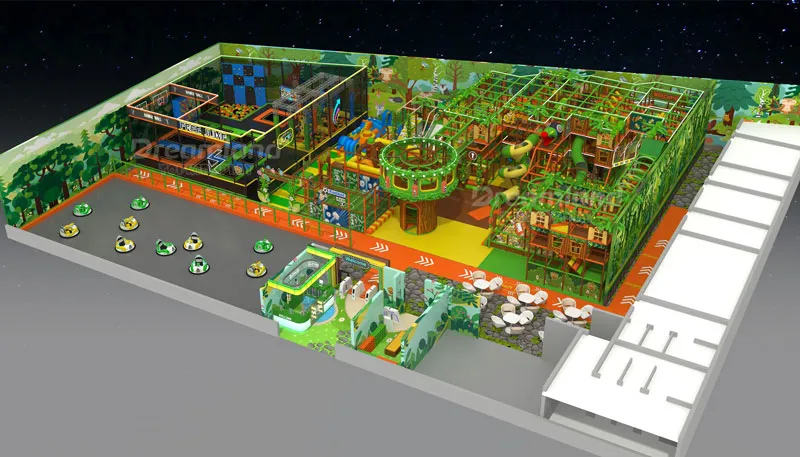
What Indoor Playground Safety Standards Apply in Different Regions?
For Indoor Playgrounds, the safety requirements are based on a combination of regulations instead of a single international certification. In every country or region, there are different frameworks for the safety of equipment, the fire performance, the building, the materials, the accessibility for people with disabilities, the control by means of inspections, and the approval by local authorities. This means that a playground that is allowed to be put up in a country might need additional testing or approval in another country.
These are the key elements of the playground’s overall regulatory compliance process: the structural and impact protection elements of the equipment standards; the material performance in a fire of the fire safety standards; the accessibility elements of the accessibility standards; and the correct installation and subsequent inspection of the playground. Local building permits and approvals of local authorities are also typically required before opening to the public.
International standards and certifications do not always guarantee compliance with commercial playground regulations of individual countries and regions, including those of the United States, Europe, the Middle East, and other countries and regions of the world. Safety compliance requirements of commercial indoor playgrounds can vary significantly from country to country and region to region, depending on the local laws and regulations, as well as recognized international standards and other relevant factors. Working with a playground manufacturer that is well acquainted with the required safety compliance requirements of commercial playgrounds in various regions and countries of the world can greatly help in minimizing the time required to obtain necessary approvals and in ensuring required safety standards and expectations are met.
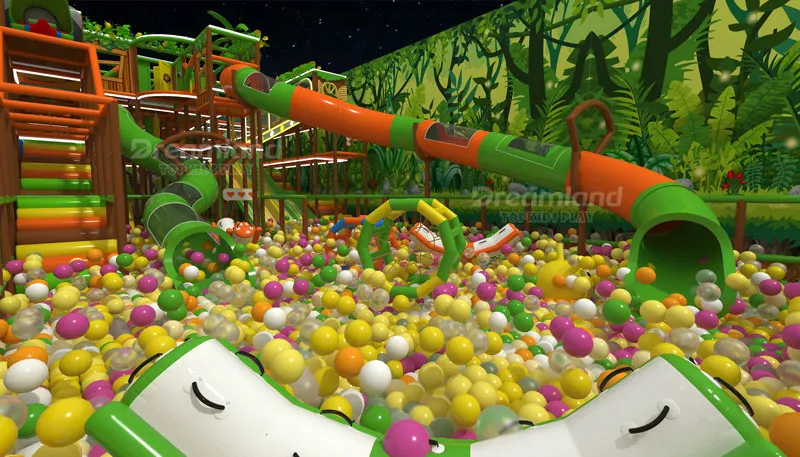
U.S. Indoor Playground Safety Standards: ASTM F1918, CPSC, IBC, and ADA
In the United States, for example, many commercial indoor playgrounds are governed by several different safety standards and building codes. Thus, while a playground may meet the requirements of one or more of the safety standards, it may not be authorized for installation and for public use.
ASTM F1918 for Soft-Contained Play Equipment
ASTM F1918 is the main U.S. safety standard for soft-contained play equipment used in indoor playgrounds. ASTM F1918 specifies requirements for the structural integrity, protective barrier, entrapment protection, impact attenuation, accessibility within the play structure, and the installation of the play structure. This standard is most commonly referenced for commercial indoor playgrounds found in family entertainment centers, in shopping malls, and in restaurants.
CPSC Requirements for Public Playground Safety
The U.S. Consumer Product Safety Commission (CPSC) has published the Public Playground Safety Handbook. This article guides designers and operators of public playgrounds with respect to the design, layout, fall protection, spacing of equipment, maintenance, and identification of hazards. This guidance is often used by state agencies, municipalities, schools, and others who review and inspect playgrounds for safety. However, the Handbook itself is considered guidance and not federal law.
International Building Code (IBC) Requirements
The Indoor Playground must be designed and constructed to meet the requirements of the International Building Code (IBC) in conjunction with the locally adopted building and fire codes. The fire-resistant construction of the building, the occupant load of the facility, the location of the emergency egresses, the sprinkler system and smoke detection system, travel distances, and structural members are examples of items that are covered under the IBC. The local building department is responsible for determining which edition of the IBC will be enforced, issuing the building permits, conducting the fire department inspections, and issuing the occupancy approval.
ADA Accessibility Requirements
The Public Indoor Playground should provide an accessible route and an inclusive play opportunity for children with disabilities, where appropriate. This shall include, but not be limited to, an accessible entrance, transfer system(s), accessible ramps, ground level play elements, accessible circulation path, and appropriate clear floor space for persons using mobility aids where required.
State and Local Approval Remains Essential
Before you can open your indoor playground, there are numerous other requirements that must be fulfilled. This includes obtaining building permits, fire department inspections, approvals with regard to the maximum number of guests, etc. These requirements often differ from state to state and even from municipality to municipality. Therefore, it is important to identify the requirements for commercial playgrounds for indoor playgrounds in the early design stages in order to avoid expensive redesigns, delays in approvals, and higher costs of construction.
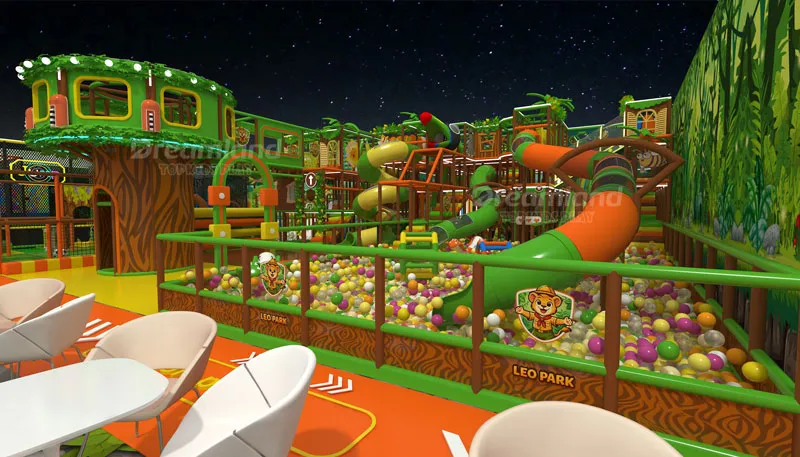
European Indoor Playground Safety Standards: EN 1176, EN 1177, and Local Regulations
In many European countries, indoor playgrounds are designed and checked according to a combination of European standards and local laws and regulations. The EN 1176 series contains the main requirements for playground equipment, but other building codes, fire regulations, accessibility requirements and checks on the playground have to be met as well, and these requirements can vary from country to country. Therefore, meeting the requirements of the EN 1176 series is not sufficient in itself to guarantee that all legal requirements have been met in Europe.
EN 1176-1: General Playground Equipment Requirements
EN 1176-1 introduces the general safety requirements for play equipment. This European standard introduces requirements with respect to the design of structures of playground equipment such as to ensure sufficient strength, sufficient stability, prevention of entrapments, and sufficient protection against protrusions, openings, and falls. Such requirements apply to all indoor play equipment that is designed to be used safely during normal use.
EN 1176-10: Fully Enclosed Play Equipment
EN 1176-10 deals with fully enclosed play equipment. A large range of indoor play equipment can be designed as fully enclosed play areas, i.e., multi-level soft play structures, enclosed activity zones, as well as, for example, long tunnel structures, 3-dimensional climbing structures, slides, bridges and enclosed observation structures.
EN 1177: Impact-Attenuating Playground Surfacing
EN 1177 contains test methods for impact-attenuating playground surfaces to check how far a surface is able to reduce the impact when a child falls on it. If for a piece of equipment a critical fall height has been determined, then playground surfaces must be provided for this play equipment within the designated play area on the surface below the equipment or surrounding it.
National Regulations and Local Approvals
As with many European countries, individual countries have their own national building regulations, fire safety codes, accessibility legislation and local authority approvals. Therefore, it is recommended to check the required local regulations for an indoor playground project in order to ensure compliance with relevant European playground standards as well as local country-specific requirements.
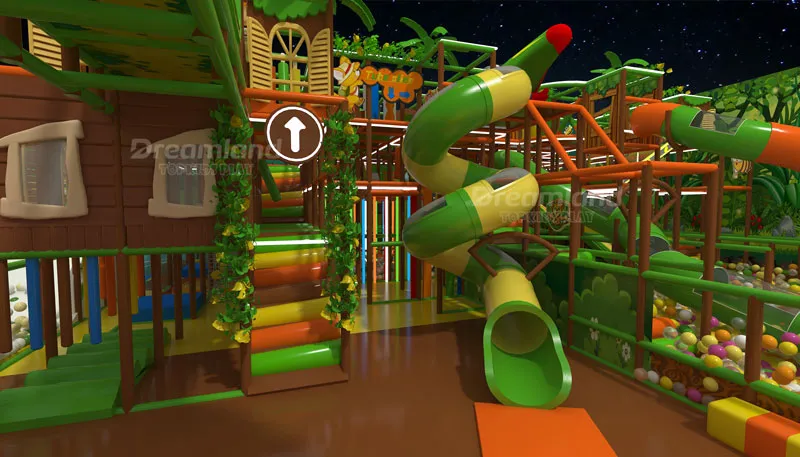
Middle East Indoor Playground Safety Standards: UAE, Saudi Arabia, and Local Approval
UAE Indoor Playground Requirements
In the UAE, indoor playground projects are often developed to combine international playground standards (e.g. ASTM or EN) with local building codes and applicable approvals from local authorities. Depending on the location of the playground, approvals may be required from local municipalities, in addition to compliance with building codes, fire safety codes, accessibility codes, etc. Structures will also be subject to inspection by local authorities prior to completion and opening to the public.
Saudi Arabia Indoor Playground Requirements
Document requirements for equipment, which is supplied by commercial suppliers of playgrounds, for example suppliers for indoor play areas in Saudi Arabia, will comply with the recognized international playground equipment standards as well as the local building code requirements of the country in which the development is taking place. The documentation that is required will cover the structural analysis of the components, the safe use of the materials that have been specified, fire performance, and the method of installation and ongoing maintenance of the components that have been specified for the development.
Civil Defence and Municipality Approval
There are a number of key approvals that must be obtained for Fire Safety Approval in order for the playground to open to the public. These are typically obtained through Civil Defence approval, and also through the Municipality for a range of permits, including Building Approvals. Final inspections are also typically required for a number of reasons.
Project Requirements Should Be Verified Early
Because regulations and requirements regarding playgrounds in the Middle East are not uniformly set, requirements for a playground must be checked during the design phase. By verifying municipality permits, requirements of the Civil Defence, specifications of the consultant as well as local building codes as early as possible, costs for redesign, approval procedures and compliance can be avoided, and a playground can be provided that is suitable for the respective destination country.
ASTM F1918 vs EN 1176-10: Key Differences for Indoor Playground Buyers
ASTM F1918 and EN 1176-10 are the two recognized international safety standards for indoor play equipment; however, they are written for two different markets and are therefore not compatible as certifications for international sales. ASTM F1918 is for sales in the USA, and EN 1176-10 is for enclosed play equipment sold in the European market. These standards would need to be met for international sales, depending on the buyer's requirements and local country approval requirements.
|
Comparison |
ASTM F1918 |
EN 1176-10 |
|
Applicable equipment |
Soft-contained play equipment used in commercial indoor playgrounds |
Fully enclosed play equipment, including multi-level soft play structures |
|
Primary markets |
United States |
Europe |
|
Related standards |
Often used with CPSC guidance, IBC, ADA, and applicable fire safety standards |
Used with EN 1176-1, EN 1177, national building codes, fire regulations, and accessibility requirements |
|
Surfacing requirements |
Fall protection is addressed within the overall safety framework and applicable project requirements |
Commonly evaluated with EN 1177 impact-attenuating surfacing requirements where applicable |
|
Testing documents |
ASTM compliance reports, material documentation, fire test reports, engineering documents, and installation records as required by the project |
EN test reports, material documentation, inspection records, engineering documents, and country-specific compliance documents |
|
Local approval |
Requires state or local building permits, fire approval, and occupancy inspections |
Requires approval under national or local regulations, including building, fire, and inspection requirements |
|
Interchangeability |
Does not automatically satisfy European regulatory requirements |
Does not automatically satisfy U.S. regulatory requirements |
Can ASTM F1918 and EN 1176-10 Replace Each Other?
No. ASTM F1918 does not establish requirements that are also requirements of EN 1176-10. Thus, meeting requirements of ASTM F1918 for safety of children’s play equipment for indoor use does not establish that all requirements for safety of fully enclosed play equipment have been met to comply with EN 1176-10, and compliance with EN 1176-10 does not establish compliance with requirements of ASTM F1918 for equipment to be installed in the U.S. for use by children.
When Should You Consider Both Standards?
Projects intended for international markets should consider assessing both ASTM and EN standards during the design phase. Many manufacturers supply equipment to multiple regions. In some cases, the developer may not have finalized the installation country. Others may be specified by the consultants who are familiar with both the ASTM and EN standards and the corresponding building codes, fire safety regulations, accessibility requirements, etc., which need to be approved by local authorities.
Indoor Playground Fire Safety and Material Compliance Requirements by Region
In addition to the requirements of the play structure itself, indoor playgrounds are comprised of a number of components that are subject to their own fire safety requirements. These include foam padding, plastic panels, netting, PVC-coated fabrics, flooring, and other materials that are used to complete the indoor playground. In the case of exports, these requirements can vary from country to country, often being governed by different fire test standards and approval procedures, such as are followed in the US, Europe, and the Middle East.
|
Compliance Area |
United States |
Europe |
Middle East |
|
Fire safety |
Building and fire codes adopted by the local jurisdiction, together with project-specific requirements |
National fire regulations based on European and local building codes |
Municipality and Civil Defence requirements, supported by project specifications |
|
Flame-spread testing |
Commonly references ASTM E84 for applicable building materials |
National or European fire classification requirements depending on the country |
Often follows project-specified ASTM or European fire test standards accepted by local authorities |
|
Textiles and netting |
Flexible fabrics and films may require testing such as NFPA 701 where applicable |
Country-specific textile fire-performance requirements |
May require ASTM, EN, or other approved fire test reports specified by consultants or authorities |
|
Foam and plastics |
Material performance depends on the applicable building code and project specifications, with supporting fire test documentation where required |
Evaluated according to applicable European standards and local regulations |
Frequently reviewed through project specifications and authority approval processes |
|
Flooring |
Fire performance and slip resistance may be required under applicable building and safety codes |
National building regulations determine flooring performance requirements |
Municipality and consultant specifications commonly define flooring compliance requirements |
|
Chemical compliance |
Materials may need to meet applicable chemical safety requirements for children's products and public-use facilities |
Materials are commonly expected to comply with applicable European chemical regulations |
Chemical compliance requirements are typically defined by project specifications or local regulations |
Fire Test Reports Must Match the Installed Materials
The validity of a fire test report is based on the tested material configuration. Changes in foam density, in the plastic used for the panels, in the type of fabric, in the used coating, in the thickness of the panels, in the used adhesives or in the production process can affect the fire performance. Therefore a report from tests conducted with a different material or from a different construction does not fulfill the requirements for the finished indoor playground.
A fire test report only applies to the actual material, product specification and assembly that was tested. Thus changes to foam density, to the plastic used for plastic panels, to the fabric of safety netting, to the PVC coating on fabrics, to flooring systems, to decorative finishes etc. need to be fire tested and get their own fire test report.
Material Compliance Is More Than Fire Performance
Material compliance also describes the chemical safety, durability, mechanical properties and other required documentation of a manufacturer, which is required by local authorities or by the project consultants. Declarations of conformity, material specifications, test reports of laboratory tests, reports of inspections and other required documents may have to be provided by a manufacturer during the approval process.
Local building, fire or related codes as well as material approvals vary by country so make sure to find out the required codes / approvals from the local building authority, fire authority or the relevant project consultant before manufacturing the components. This will avoid any delay in getting approvals and in the worst case scenario have to change the materials which can end up being very expensive during the construction phase.
Indoor Playground Safety Documents, Inspections, and Maintenance Requirements
Safety compliance is not limited to the time of manufacturing and installation of the playground. U.S. standards, European standards and Middle Eastern standards for example, all need to be met in terms of maintaining technical documentation for the playground and an inspection and maintenance program to ensure safe use throughout the service life of the playground. This will also support building authorities, inspectors and insurance providers to review records for the playground.
Essential Safety Documents Buyers Should Request
Before approving production or installation, request documentation that verifies the playground's design, materials, and compliance. Common documents include:
- General arrangement and installation drawings
- Structural and component drawings
- Bill of materials and material specifications
- Applicable equipment safety test reports
- Fire test reports for foam, plastics, fabrics, netting, flooring, or other required materials
- Material compliance declarations and certificates, where applicable
- Installation manual and assembly instructions
- Operating and user guidelines
- Risk assessment documentation
- Inspection and maintenance manual
- Spare parts list and replacement recommendations
- Warranty documentation
Factory Testing vs. Post-Installation Inspection
This would include verifying that all of the components and the materials that have been used in the manufacturing of the playgrounds comply with the appropriate design and performance requirements for a product of this nature prior to it being shipped from the factory.
Post-installation inspections of the playground on site after it has been put up by the supplier, are made to check that all components of the playground have been set up according to drawings and according to supplier’s instructions. All components of the playground, i.e. protective barriers, fasteners, safety clearances, access points, etc. are checked to see if they function as intended.
Routine Operational Checks
Routine inspections help identify issues caused by daily use before they become safety hazards. Depending on playground usage, operators should regularly check:
- Loose or damaged fasteners
- Worn netting and ropes
- Torn padding or protective coverings
- Damaged slides and play panels
- Floor surface condition
- Signs of excessive wear or vandalism
- General cleanliness and housekeeping
Periodic and Annual Inspections
Indoor playgrounds require periodic inspections to check the stability of the structure, the wear of critical parts, the functioning of safety protection, impact areas, replacement parts and overall condition of the equipment. The majority of commercial facilities have their indoor playgrounds inspected on an annual basis by an experienced inspector. The aim of these inspections is to check whether the playground continues to comply with relevant safety standards, whether the necessary maintenance work has been carried out and whether the playground is safe for use.
Maintain Complete Inspection Records
All the records from the inspections, from the maintenance, from the repairs, and from when parts were replaced need to be kept throughout the entire life of the playground. These records show that any equipment on the playground has been properly looked after. These can also be needed when any place looks into your compliance with any of the safety regulations, as well as when any place looks into your insurance.
Indoor Playground Safety Standards Checklist for International Buyers
A proper set of safety standards for an indoor playground is based on the location of the playground, in order to check for the relevant standards of different countries. A project developer should make sure of the applicable standards prior to starting on the design, the production of parts and the procurement of materials. Using a structured checklist for the required compliance saves a lot of time for redesign, for missing documents and for decisions required for approval of plans.
Indoor Playground Compliance Checklist
|
Checklist Item |
What to Verify |
|
Supplier selection |
Choose a manufacturer with experience supplying projects in your destination country and familiarity with the applicable standards and approval process. |
|
Safety standard confirmation |
Confirm whether the project requires ASTM F1918, EN 1176, EN 1177, or other standards specified by local authorities or consultants. |
|
Building and fire code review |
Identify the applicable building code, fire safety requirements, occupancy rules, and accessibility regulations before finalizing the design. |
|
Material approval |
Verify that foam, plastics, netting, PVC-coated fabrics, flooring, and other materials meet the project's fire and material compliance requirements. |
|
Document review |
Request drawings, material specifications, engineering documents, test reports, installation manuals, maintenance manuals, and risk assessments before production. |
|
Fire test verification |
Ensure every fire test report corresponds to the exact material, thickness, construction, and specification supplied for the project. |
|
Installation inspection |
Confirm that the playground is installed according to the approved drawings and manufacturer instructions before public use. |
|
Local permits and approvals |
Obtain all required building permits, fire authority approvals, municipality approvals, occupancy certificates, and other jurisdiction-specific authorizations. |
|
Pre-opening preparation |
Complete final inspections, staff training, maintenance planning, emergency procedures, and documentation review before opening the facility. |
Conclusion
Indoor playground safety is determined by the destination of your indoor playground project and can vary from market to market. Compliance to certain international safety certificates is often misunderstood. Most recognized safety standards, building regulations and fire codes along with relevant material compliance, installation and ongoing inspection procedures are needed to achieve certain levels of safety in an indoor playground and to gain the required local approvals to operate such facilities.
By confirming all of the relevant project specific compliance requirements with your chosen manufacturer and project consultant early on in the design process, any costly redesigns can be avoided, as well as any potential installation delays. Ensuring that your Indoor Playground is safe and meets the relevant legal requirements of the destination that it is traveling to, is also of utmost importance.
FAQ
What Is the Main Indoor Playground Safety Standard in the USA?
ASTM F1918 is typically used for soft-contained indoor play equipment. Additional requirements may be necessary for items such as trampolines, which would fall under the requirements of ASTM F1487. In addition, project requirements may fall under CPSC guidelines, IBC requirements, ADA regulations as well as state and local requirements and approvals.
What Is the European Standard for Indoor Playgrounds?
EN 1176 is the European Standard for playground equipment in general, EN 1176-10 specifically for fully enclosed play structures, while EN 1177 deals with impact-attenuating surfaces. However, local building and fire regulations may also apply to indoor playgrounds.
Do Middle East Indoor Playgrounds Follow ASTM or EN Standards?
Many indoor playgrounds across the Middle East adopt both the international standard ASTM and the European standard EN. The municipality and Civil Defence also have to approve the playground, other than the issuing of the international safety certificate.
Are ASTM F1918 and EN 1176-10 Equivalent?
No. They address similar safety areas but are different standards systems and cannot be considered automatically interchangeable.
Is CE Marking Enough for an Indoor Playground in Europe?
CE marking does not replace an assessment, risk evaluation, installation inspection, fire safety requirements and approval by local authorities.