

DIY vs Professional Installation for Indoor Playgrounds
Choosing between DIY and professional indoor playground installation depends on more than the installation fee. You need to consider your team's technical skills, available labor, project schedule, equipment complexity, quality-control process, and who will be responsible for problems during installation.
Owner-managed installation can work when you have an experienced team, suitable tools, enough labor, clear installation drawings, and reliable support from the playground supplier. Professional playground installation is generally more suitable when the project involves complex structures, tight deadlines, limited in-house expertise, or multiple contractors that need coordinated management.
Before deciding, evaluate the total installation cost, required manpower, project timeline, quality checks, safety responsibilities, and post-installation support rather than comparing labor prices alone.
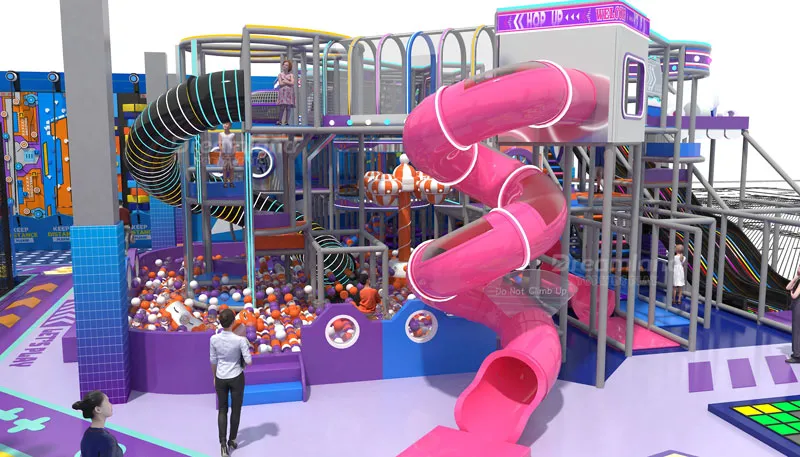
Understanding DIY and Professional Installation
Even if the owner is performing the DIY indoor playground installation themselves, it does not necessarily mean that they will be building the components themselves. Most commercial owners will assemble an in-house team or use local labor to complete the installation under the owner’s supervision. The owner will coordinate all aspects of the installation, including the required tools and working hours.
Professional playground installation refers to the agreed installation scope being carried out by experienced installers, whether this is the supplier’s own installation team, an independent specialist or local contractor who is appointed by the client.
Some important distinctions have to be made here. First, DIY installation does not necessarily have to mean that the owner himself is assembling all components. He might organize a capable in-house team or local crew to complete the installation, while he coordinates labor, tools, etc. and controls the schedule and the quality check at the end of the installation. He remains responsible for the scope of work agreed upon with the playground supplier, though.
It is essential to compare like with like when it comes to a DIY vs professional indoor playground installation, and this means comparing the same playground, at the same location, with the same scope of work. A lower price for an owner-managed installation may include elements that have been excluded from the supplier’s quote.
Therefore, when comparing DIY vs. professional indoor playground installation, compare the same commercial indoor playground model, site and scope of work. Don’t just compare the installation price tag. Also list out all the costs that one option may exclude but the other includes.
DIY vs Professional Indoor Playground Installation: Key Differences
|
Factor |
DIY Installation |
Professional Installation |
|
Labor |
Owner provides or hires local labor |
Supplier or specialist crew provides installers |
|
Technical experience |
Requires capable in-house or local workers |
Installation experience is provided by the crew |
|
Upfront labor cost |
May be lower |
Usually includes installation charges |
|
Project management |
Owner manages the installation |
Installer manages installation activities |
|
Scheduling |
Depends on local team availability |
Coordinated with the professional crew |
|
Quality control |
Owner/team must verify installation |
Installer performs installation checks within its scope |
|
Supplier support |
Often depends on the supplier agreement |
Usually more direct during installation |
|
Complex layouts |
Requires strong technical capability |
More suitable for complex installations |
|
Responsibility |
More responsibility remains with the owner |
Responsibilities can be defined in the installation contract |

Compare the Total Installation Cost
When calculating the cost of owner-managed installation, it is essential to include all costs for the local labor, the time of the supervisor, tool or equipment rental and transportation as well as any other support that might be required on site. Be sure to include rework costs for components that need to be re-tightened or even completely reinstalled. Your time as manager has a value as well.
First identify the supplier’s or contractor’s service fee. Then check if any expenses such as travel, accommodation, transport, and unloading of equipment will be charged on top of the basic service fee. Then find out who is responsible for tasks such as local labor, site preparation, and handling of equipment.
For a DIY project, calculate more than employee or contractor wages. Include:
- Local labor costs
- Tools and equipment
- Lifting or access equipment
- Transportation and unloading
- Installation supervision
- Contractor coordination
- Travel or accommodation where required
- Potential rework
- Site preparation
- Inspection and correction costs
In assessing shared costs, ensure these remain constant between supplier and contractor. If, for example, site preparation or, even more so, the unloading of equipment is to be included in the supplier’s costs, then ensure these are reflected within your assessment of the contractor’s costs too.
A useful comparison is therefore:
Total DIY cost = labor + equipment + supervision + logistics + rework risk + project-management time
Total professional cost = installation fee + related site/logistics costs + any excluded work.
Be sure to use confirmed quotations and scope of work documents rather than ‘estimated’ figures – you will be surprised how often these can be ‘upgraded’ during the installation process and result in additional, unexpected costs.
Evaluate Skills, Tools and Local Support
Before choosing between DIY and professional indoor playground installation, it is essential to assess whether your team is capable of handling the necessary equipment and installation process correctly. Such teams will typically have prior experience of installing similar playground systems, and they will need to understand the manufacturer’s drawings, identify the various components, and adhere to the specific sequence of installation laid out by the manufacturer. Moreover, the team members will require access to the various tools specified by the manufacturer prior to the commencement of the work.
It's best to have one person supervise the installation of an indoor play structure and this should be the site supervisor of your construction team. This person needs to have adequate knowledge of the structure to ensure that the correct installation methods are used and that all components are used. Where specialist tasks are required, these should be carried out by people with the appropriate skills and not just given to general laborers to complete.
Ask your team or installer these simple practical questions before you consider starting the installation:
- Have you installed this type of indoor playground before?
- Can you provide examples of previous commercial installations?
- Who will supervise the work on site?
- How many trained workers will be available?
- Do you have the required tools and equipment?
- Who handles technical questions during installation?
If your local team has experience, tools, and reliable technical support for the indoor playground, then an owner-managed installation would be more suitable. However, if not, then professional playground installation is more suitable.
Compare Scheduling and Coordination Needs
The number of workers available for installation is just one factor that affects the overall duration of the project. The time it takes for an experienced crew to complete a playground installation can be significantly less than that of an owner-managed team who require time to become familiar with the playground and to study drawings and component parts in detail in order to organize them for installation.
Make sure the site is ready for installation. This includes completion of flooring, electrical work, lighting, walls, access routes, storage areas, etc. Check the scope of works to confirm the required site preparations have been completed. Also check the delivery of the equipment to be installed will occur prior to the installation date.
Make sure your supplier or installer knows that even though they are doing the work, you still expect delivery, site preparation, access, materials, local support, etc. to be in place for the agreed start date and the installation to be completed by the agreed completion date.
Ask the supplier or installer for a detailed project schedule which outlines the delivery date and time, installation dates and times, any required site inspections, any necessary rectification work or adjustments, final checks and handover. Without a schedule such as this you will have no way of knowing when delays in installation will start to affect the rest of your project.
Clarify Safety Checks, Handover and Warranty
Whatever approach is taken for the installation of the playground, it is essential that someone takes on safety responsibilities. These responsibilities need to be clearly assigned and followed, regardless of whether the work is being undertaken by the owner with a DIY installation or by professional contractors. In both cases the safety responsibilities need to be clearly assigned within the project team and included in the scope of work for the contractor.
Outline the handover process and what local records will be passed over to you after completion of the installation. It is also wise to detail who reports any defects, who undertakes the repair and who confirms completion of any work carried out to rectify any discovered defects.
Ensure local site inspections, approvals and regulatory reviews are treated separately from the completion of physical assembly. Verify the local site and project requirements and who is responsible for obtaining required approvals.
Make sure that any structural, electrical, anchoring or similar work is carried out by suitably qualified personnel. Do not try to treat such work as normal assembly work and assign it to the normal assembly team.
Check the warranty terms for the equipment you are purchasing and the installation arrangement prior to commencing work. The published warranty information on the Dreamland website states that warranty coverage for the equipment shall be limited to the period and uses specified by Dreamland, provided that installation and maintenance instructions have been complied with.
Also keep a record of the installation (including copies of all completed checklists and inspection reports), any subsequent maintenance, any correction work undertaken, and all supplier communications. These records will serve as a clear history of the project and provide evidence that the equipment has been installed and subsequently maintained in line with the relevant requirements.
Choose an Installation Method That Fits Your Project
Instead of making a decision based on the overall size of the playground, it is more important to consider the actual complexity of the system and the support available to manage the delivery and installation from start to finish.
When Owner-Managed Installation May Be Practical
Owner-managed installation is possible if the team and necessary equipment are available for the required amount of time. This team should be able to read drawings, organize necessary parts, follow instructions for the equipment and spot potential problems whilst building.
Confirm supplier support: confirm who is available to answer technical questions and clarify differences between the components and the drawings, and who to contact in the event of any installation problems. Make sure there is a site supervisor who is responsible for the management of the site and the workers to ensure the work is completed on time.
While a small indoor play area may appear to be a simple DIY project, it contains many complex components, including anchors and interfaces to other specialist equipment, and requires detailed assembly procedures. Conversely, a larger playground is not necessarily a more difficult project for an experienced company with suitable resources.
When Professional Installation Is Worth Prioritizing
In cases where a team does not have the experience to safely and successfully complete the installation of the indoor play equipment, then professional playground installation would be worth prioritizing. In addition, a complex system requiring specialist trades would also benefit from experienced installation services.
Just remember that an experienced playground installer will be able to coordinate the dismantling and reassembling of your playground, conduct necessary inspections and make any necessary corrections, and then hand over the completed system to you. However, you need to understand what work your selected installer will be responsible for completing.
Quick Decision Checklist
Before choosing, ask:
- Are the required tools and time available?
- Are the total costs comparable?
- Who checks, approves, and accepts the completed work?
- Is the team capable of installing this specific system?
- Is the supplier or installer support scope clear?
Your answers should determine the installation arrangement—not the project size alone.
A Practical Decision Checklist
|
Question |
If Yes |
If No |
|
Does your team have relevant installation experience? |
DIY may be workable |
Consider professional support |
|
Do you have enough trained workers? |
DIY may be workable |
Professional installation may simplify labor arrangements |
|
Are the required tools available? |
DIY may be practical |
Include rental or purchase costs |
|
Does the supplier provide clear installation documentation? |
DIY is easier to plan |
Request documentation first |
|
Is the playground relatively straightforward? |
DIY may be manageable |
Professional experience may be useful |
|
Is the opening deadline flexible? |
DIY has more room for adjustment |
Professional scheduling may be useful |
|
Can you manage quality checks? |
DIY may be workable |
Define professional inspection support |
|
Are installation responsibilities clearly documented? |
Proceed with defined scope |
Clarify before installation |
Discuss Your Installation Options with Dreamland Playground
Customers can also refer to installation resources such as drawings, reference images and videos to organize their own installation. For projects that require help from experienced installers, Dreamland Playground also offers professional installation.
Installation costs are calculated separately from the cost of the playground equipment and therefore should be included in your project budget. Obtain a quotation for installation based on the equipment to be installed, site details and the required scope of work, rather than using a general installation estimate.
Contact Dreamland Playground with the address of where you intend to open your project, what equipment you intend to purchase, who your local team is and what your opening date is. This allows us to discuss the best installation options for your project and outline the support we can offer, including a rough time scale and cost.
The key aim is to select an installation option that suits your team’s skills, time scale and budget, and clearly sets out responsibilities from installation through to handover.
Frequently Asked Questions
Can I Install a Commercial Indoor Playground Myself?
It is possible for you to organize the installation of the equipment provided. Your team will need to be competent to read installation drawings and organize all parts required for installation, together with manufacturer information and other relevant details. It is also important to confirm with the supplier the installation documentation available, together with any technical support required, required inspections and who is responsible for putting right any installation problems found.
Is DIY Installation Cheaper Than Professional Installation?
Don’t automatically assume that having the equipment installed yourself will save you money. In fact, to calculate the cost of an owner-managed install, you need to factor in the labor, tool rental, supervision time, travel, accommodation and other installation expenses. Compare like with like and include any local additional costs that a professional installation provider may charge. Obtain matched quotations from suppliers of similar experience and with the same scope of works and cost assumptions.
How Long Does Each Installation Method Take?
The time required to complete installation will depend on several factors including the complexity of the equipment, the number of people in the installation team, their level of experience and how ready the site is to receive the installation. This will also include the time taken for the equipment to be delivered to site and for any necessary inspections to be completed. Owner-managed installations will also require time for planning and learning how to complete the installation. An experienced installation crew will already be familiar with similar products and installations and can complete the work within a shorter time frame.
What Support Does Dreamland Provide for Customer-Organized Installation?
When purchasing from Dreamland, you can find out about the information we provide to customers who are going to complete the installation themselves, such as drawings, reference photographs and videos, and ask for contact details for technical queries, installation support, etc. Also find out what your obligations are as a customer completing the installation and what evidence we will require you to retain.
Will DIY Installation Affect My Warranty?
Dreamland’s published warranty information shows how warranty coverage relates to compliance with the installation instructions and with the required maintenance for the equipment. Check the written warranty for your specific items and check how issues with installation are dealt with and what evidence needs to be retained. Although DIY installation does not automatically mean that all warranty coverage will be withdrawn, this would be something to check prior to installation.